

What is WebAssembly? And Why It Matters for Modern Web Applications
Ankit Suyal
@ankitsuyal
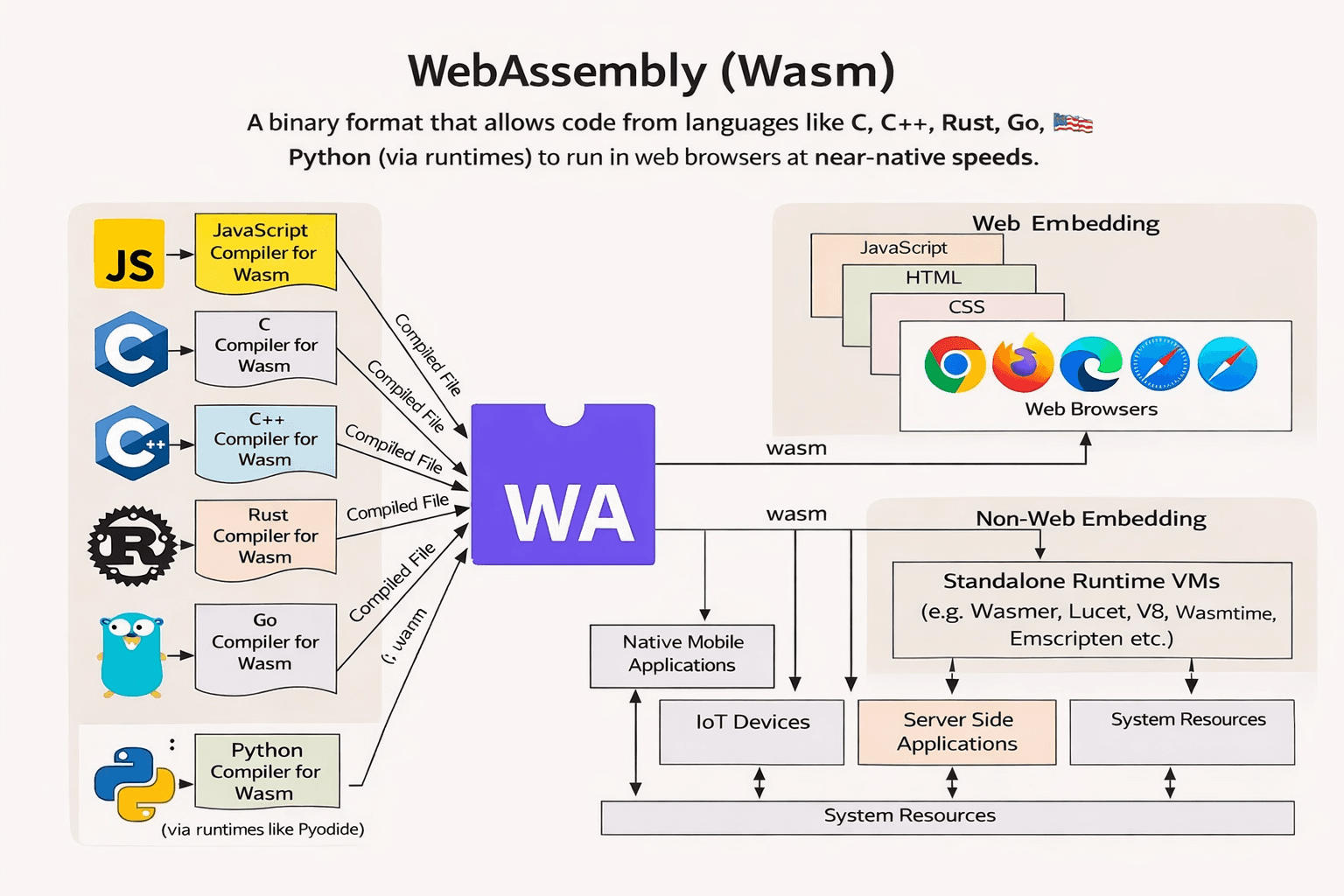
Web development is evolving fast.
Earlier, websites were mostly built using HTML, CSS, and JavaScript. That still works — but modern web applications now demand much higher performance.
This is where WebAssembly (WASM) comes in.
Let’s understand it in simple terms.
What is WebAssembly?
WebAssembly is a low-level binary format that runs directly inside modern web browsers.
It allows languages like:
- C
- C++
- Rust
- Go
- Python (using WebAssembly-based runtimes)
to run in the browser with near-native performance.
Normally, browsers execute JavaScript. But with WebAssembly, heavy tasks can be compiled into a special
.wasmIt does not replace JavaScript — it works alongside it.
Think of it like this:
- JavaScript → Handles UI and interaction
- WebAssembly → Handles heavy computation and performance-critical logic
Together, they create powerful web applications.
Why WebAssembly Is Important
Performance is no longer optional.
Users expect:
- Fast loading
- Smooth interaction
- No lag
- Instant response
Even a few seconds of delay can reduce trust and conversions.
WebAssembly helps improve performance in situations where JavaScript alone may struggle.
How WebAssembly Improves Apps
1 Faster Execution
WebAssembly is compiled into a binary format.
Browsers can execute this binary format much more efficiently than plain JavaScript code.
Result:
- Faster calculations
- Smoother animations
- Better responsiveness
2 Handles Heavy Tasks Easily
WebAssembly is especially useful for:
- Image processing
- Video editing in browser
- 3D graphics
- Data visualization dashboards
- Financial calculations
- Encryption and security
- Real-time tools
If your web app needs serious processing power, WASM helps.
3 Reduces Server Load
Some heavy operations can run directly inside the browser using WebAssembly.
This means:
- Less dependency on backend servers
- Faster user response
- Lower infrastructure cost
For SaaS products, this is very powerful.
4 Near-Native App Experience
With WebAssembly, web apps can feel closer to desktop applications.
Examples:
- Design tools
- Browser-based IDEs
- CAD tools
- Gaming engines
- AI-powered tools
Web browsers are no longer just document viewers — they are application platforms.
How WebAssembly Works (Simple Flow)
- Developer writes code in C / Rust / Go etc.
- Code is compiled into a
file.wasm - The file is loaded into the browser
- JavaScript interacts with it
- Browser executes it inside a secure sandbox
It’s safe, fast, and efficient.
Can You Use WebAssembly in React or Next.js?
Yes.
You can load
.wasm- React
- Next.js
- Vue
- Plain JavaScript apps
Most modern frameworks support it.
For example:
- Performance-critical modules can be built in Rust
- UI can remain in React
- Both work together seamlessly
When Should You Use WebAssembly?
You should consider WebAssembly if you are building:
- SaaS platforms
- High-performance dashboards
- AI-based web tools
- File processing systems
- Real-time business applications
- Web-based design or editing tools
You probably don’t need it for:
- Simple landing pages
- Basic portfolio sites
- Static informational websites
Like any technology, it should be used where it adds value.
Why This Matters for Businesses
A fast application:
- Builds trust
- Improves user experience
- Increases engagement
- Improves conversion rates
- Reduces bounce rate
Performance directly impacts business outcomes.
As a developer, I focus not just on design — but on architecture and long-term scalability.
WebAssembly is one of the technologies that helps build future-ready web applications when performance truly matters.
Final Thoughts
The web is evolving beyond traditional websites.
With WebAssembly, browsers can run powerful, high-performance applications — not just display content.
If you're building something serious, performance must be part of the foundation.
And technologies like WebAssembly make that possible.
Loading comments…